
The Same Coach, Twice
Ron James, Team Takeover, and How One Man Built a Development Pipeline That Runs From the Third Grade to the WNBA Draft

When Madisen McDaniel committed to the University of South Carolina in 2023, she was described as one of the top point guards in the country, a South Carolina signee finishing her career at one of the most nationally prominent girls’ basketball programs in the DMV. Asked about her new head coach, Ron James, she said something that stopped people who hadn’t been paying close attention.
“I’ve known him since I was in the third grade,” she said.
That is not a recruit talking about her new coach. That is a player describing a relationship that had been running, without interruption, for roughly eight years. Ron James was her AAU coach long before he became her high school coach. He knew her game. She knew his voice. The transition from summer ball to the WCAC was not a transition at all — it was a continuation.
This is the story inside the Bishop McNamara story. The program’s success cannot be fully explained without understanding Team Takeover — what it is, how Ron James built it, and how it and Bishop McNamara became, functionally, the same pipeline.
What Team Takeover Is
Team Takeover is a Nike-sponsored AAU program based in Washington, D.C. It was founded by Keith Stevens, who built the boys’ program into one of the most respected grassroots organizations in the country — a DMV institution that has produced NBA-level talent and, in the words of The Washington Post, made Stevens “the new power broker of D.C. area basketball.”
In the boys’ game, Team Takeover was already a known quantity. Stevens had built it from nothing into a Nike EYBL program — the Nike Elite Youth Basketball League is the top tier of American grassroots basketball, the circuit where the best high school players in the country compete every spring and summer and where college coaches come to evaluate talent. To get a Nike EYBL invite is to be recognized as one of the country’s elite programs.
The girls’ program came later. In 2012, Ron James was brought in to build a girls’ division for Team Takeover from the ground up. He was given the mission, the organizational infrastructure, and the Nike affiliation. What he built with it, over the next decade-plus, would eventually reshape girls’ basketball in the entire DMV region.
What James Built from Scratch
The numbers are staggering when you lay them out in sequence. Starting in 2012, Ron James built a girls’ program within Team Takeover that, by the time he took the Bishop McNamara head coaching job in 2023, had accumulated:
Over 650 wins as head coach of Team Takeover’s 17U Nike EYBL team and 8th grade Nike Jr. EYBL team. More than 75 players helped to earn Division I scholarships. Eight McDonald’s All-American athletes. Twelve Jordan Brand Classic All-Americans. Multiple USA Today, Naismith, WBCA, and First-team All-American honors. Gold and silver medals for Team USA. Three separate recognitions from Silver Waves Media on their “100 Most Impactful People in Women’s Basketball” list.
That is not the portfolio of an AAU coach who ran a summer program. That is the portfolio of a developer — someone who spent more than a decade building individual players from middle school through the end of their high school careers, watching them arrive at college programs across the country, and doing it repeatedly, with different groups of girls, year after year.
James himself described the philosophy simply: “Focusing on developing exceptional players by promoting leadership, discipline, and sportsmanship across his program to ensure lifelong success for his student-athletes.” That language — “lifelong success” — is not language that comes from someone whose horizon is the next tournament. It is language that comes from someone whose definition of development extends past the last game of the season.
He also, crucially, had a background that went beyond basketball. James brought 27 years of educational experience — in Prince George’s County Public Schools and Fairfax County Public Schools. He earned a Master of Science in Educational Leadership from George Mason University and a Bachelor of Science from Lincoln University. He was not just a basketball coach. He was an educator who coached basketball.
The Structure of the Pipeline: How It Actually Works
The Team Takeover Girls program runs teams at multiple age levels — most notably the 8th grade Nike Jr. EYBL team and the 17U Nike EYBL team. This means James was meeting players as early as seventh and eighth grade and developing continuous relationships with them through their final year of high school eligibility.
Madisen McDaniel’s comment — “I’ve known him since I was in the third grade” — suggests the relationships sometimes started even younger, in recreational or pre-EYBL contexts. Whatever the entry point, the effect was the same: by the time a player arrived at Bishop McNamara, she already had years of shared history with the man who would be coaching her in the WCAC.
For Zhen Craft, who signed with Georgia and anchored the 2024–25 national championship team, James said: “I coached her the hardest because of her IQ, and how multi-talented and versatile she is.” He knew exactly what kind of player she was because he had already spent years developing exactly that.
For Qandace Samuels — a sophomore during the championship season, the younger sister of UConn forward Qadence Samuels — the Team Takeover connection meant she arrived at McNamara already knowing the program’s standards, James’s coaching style, and what was expected of her. She didn’t need an adjustment period. She needed a chance.
The result, as James told High School On SI during the 2024–25 season: “Nine players led Bishop McNamara in scoring in a game.” That depth — that willingness of players to accept reduced individual roles in service of the team — is not built in one season. It is built over years of a shared developmental culture. It is built across summers in the Nike EYBL circuit and winters in the WCAC.
The Older Connection: Scott, King, and the Pre-James Era
The connection between Team Takeover and Bishop McNamara predates Ron James’s arrival as head coach. It runs through the Frank Oliver era as well.
Madison Scott and Liatu King — the Class of 2020, the two players who were drafted by WNBA teams in 2025 — both played AAU basketball for Team Takeover while attending Bishop McNamara under Coach Oliver. Their summer development was happening under James while their WCAC development was happening under Oliver. Two different coaches. Two different environments. The same player, the same trajectory
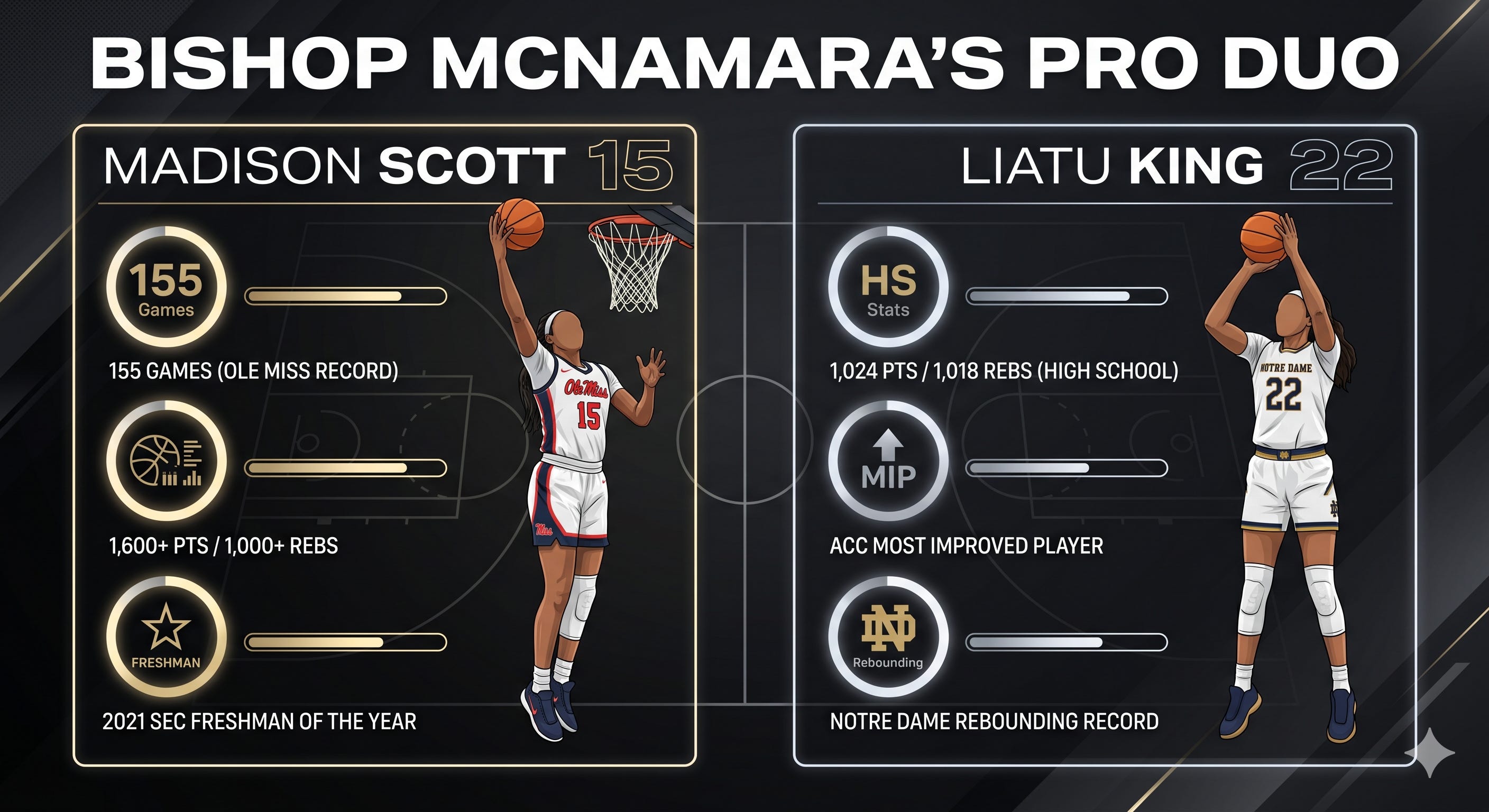
.
Liatu King “led her AAU team to the 2019 Nike EYBL championship” according to her Notre Dame biography. That was Team Takeover, under James, the summer before her senior year at Bishop McNamara under Oliver. She won an EYBL championship in the summer, then won the WCAC championship the following winter. Same development philosophy, two settings.
This overlap meant that when James took over as McNamara’s head coach in August 2023, he wasn’t inheriting a foreign program. He was stepping into the school side of a pipeline he had already been running for a decade. He already knew many of the players. He already knew the competitive environment. And — critically — the players already knew him.
What Makes This Unusual — and What It Means for Women’s Basketball
In men’s basketball, the AAU-to-high-school pipeline relationship is widely discussed, often critically. The influence of shoe companies and AAU programs on recruiting decisions has been scrutinized at every level. But the conversation in women’s basketball has historically been different — partly because the women’s grassroots infrastructure has received far less media attention, and partly because the dynamics of how women’s players are developed and recruited have not been subject to the same scrutiny.
What the Team Takeover – Bishop McNamara relationship represents, at its best, is a coherent philosophy applied across multiple years and multiple environments. James did not build Team Takeover Girls as a recruiting funnel for one school. He built it as a development program. The fact that many of those players ended up at Bishop McNamara when he became the head coach there is a reflection of trust — the trust players and families had in a coach they had known for years.
The athletic director at Bishop McNamara, Marty Keithline, said it plainly when announcing the hire: “Ron James has done extraordinary work developing the Team Takeover girls’ basketball division. His dedication to his players and their success makes him an excellent choice to be the next leader of the Bishop McNamara girls’ basketball program.”
The school wasn’t just hiring a basketball coach. It was formalizing a relationship that had already been producing elite players for over a decade.
The Broader Vision: Year-Round Development
Team Takeover Girls plays year-round — AAU tournaments, the GBOA (Grassroots Basketball of America), the Nike EYBL circuit in the spring, and fall and winter leagues. This is not a two-week summer camp. This is a continuous competitive and developmental environment that operates parallel to the high school calendar.
For a player like Qandace Samuels, who is one of the program’s top current prospects, the basketball year has almost no off-season. She is developing under James’s coaching from approximately the time school lets out in June until it restarts the following school year — and then she is playing for him again in the WCAC from November through March. The windows of time when she is not under his direct development influence are narrow.
This is not unusual for elite-level women’s basketball. But it is unusual for the same coach to be the constant across both environments. Most elite players develop under one coach in AAU and a different coach in high school. At Bishop McNamara, for a significant portion of the current roster, those two coaches are the same person.
When James said, during the national championship run, “The area is extremely tough — brutal and competitive,” he was speaking as someone who had spent over a decade in that brutally competitive environment, summer and winter, year after year. He was not discovering the DMV’s competitive landscape. He had helped create it.
A Note on What This Means for the Database
For the purposes of our Maryland D1 database and the DOAGBC project, the Team Takeover connection raises a question worth tracking: how many of the players in our database with Bishop McNamara as their high school also played for Team Takeover at the AAU level? The answer is likely most of the recent ones, and tracking that overlap would provide a richer picture of how elite talent is being developed in Prince George’s County specifically.
The broader point for the article: when we say Bishop McNamara “produced” Madison Scott and Liatu King, we are being accurate but incomplete. They were also produced by Team Takeover. They were developed in both environments simultaneously, by coaches who, whatever their differences, were operating from a shared vision of what elite women’s basketball development looks like.
That shared vision is the real story. The WCAC championship banners and the WNBA draft picks are the evidence.
Diary of a Girl’s Basketball Coach · doagbc.substack.com · doagbc@gmail.com