
The Publicist
Breezy Bishop Was Five Feet Tall, Coached Girls’ Basketball at Western High School for 24 Years, Won 424 Games, and Put 63 of 64 Players into College on Scholarships.

She Is the Only Maryland Girls’ High School Coach in the Women’s Basketball Hall of Fame. And She Did It All With a 20-Page Booklet She Wrote, Funded, and Mailed to Every College in America.
Every fall, before the season started, Breezy Bishop sat down and wrote a booklet.
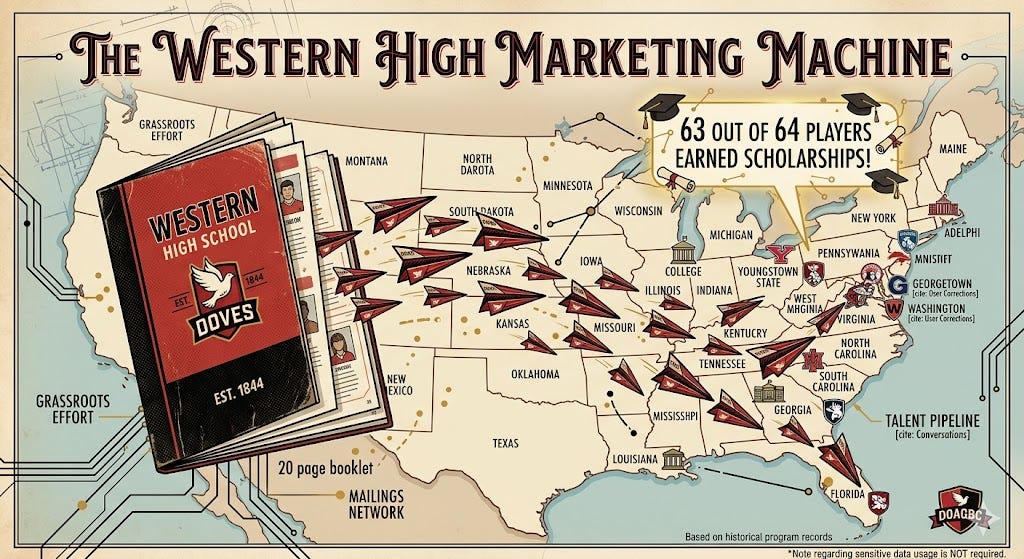
Twenty pages. Illustrated. She called it “Western High School Doves.” She raised the money to print it herself. And then she mailed it to the athletic department of every college in the United States of America — from Adelphi to Youngstown State, she said, including the Naval Academy, West Point, and the Ivies. Every college heard about her Doves.
Inside the booklet: pictures of school administrators and program supporters. Academic statistics. And most importantly, her players — freshmen, sophomores, juniors, and seniors. Every year. All four classes. “These kids are not just good athletes,” she wrote. “They’re good kids — they’ve learned to work hard and study hard.”
She described her role at Western High School this way: “I market every student to the best colleges in the country.”
She was a girls’ basketball coach. She was also, before anyone in high school athletics had a name for it, a college placement operation for young women from Baltimore City who otherwise would not have had anyone advocating for them at that level.
Over seventeen years, 63 of her 64 players who applied for college scholarships received them — athletic or academic or both. She said it plainly: “That has to be one of the best records of any high school anywhere in the country.”
She is right. And she is the only Maryland girls’ high school basketball coach in the Women’s Basketball Hall of Fame.
This is the story of Breezy Bishop. It is the story of the second role model I chose when I was starting out as a coach. Her name was the second of two. And I want this article to be the fullest account of what she built that has ever been published outside of Baltimore.
The Girl Who Played with the Boys
Barbara Jude Bishop was born on September 7, 1935. Her family called her Breezy. The nickname stuck for ninety years and counting.
She grew up in Baltimore with three brothers who served in the Army, the Navy, and the Marines. Her grandmother, by the accounts that survive, knew from early on that Breezy would make her contribution to sports. In her early teen years, her mother and grandmother worried because she was always playing sports with the boys in her neighborhood. They were so concerned about this that they sent her to Girl Scout camp, perhaps hoping the outdoors experience would redirect her interests.
It did not redirect her. It expanded her. She came home from camp with new curiosity about swimming, hiking, and canoeing. She went on to play basketball, softball, and track and field in high school.
She wanted to major in physical education in college. Her father would not support her financially to do it. This is the first obstacle in the Breezy Bishop story, and it is the one that might have ended everything before it started. It did not. She found another path. She got to college, she got her degree, and she eventually came back to Baltimore to teach physical education and health and coach track and field — and, eventually, basketball.
She arrived at Western High School in the 1970s. Western is the oldest female public high school in America — founded in 1844, when the city of Baltimore established a school specifically for the education of women in a time when such institutions were rare. Breezy Bishop and Western High School were made for each other. A woman who had spent her whole life fighting for the right to compete. A school that had spent 130 years giving women the space to learn.
424 Wins, 17 City Championships, and a Win Percentage That Belongs in a Different Conversation
Let me put Breezy Bishop’s record on the table before I discuss anything else, because the record is the foundation on which everything else rests.
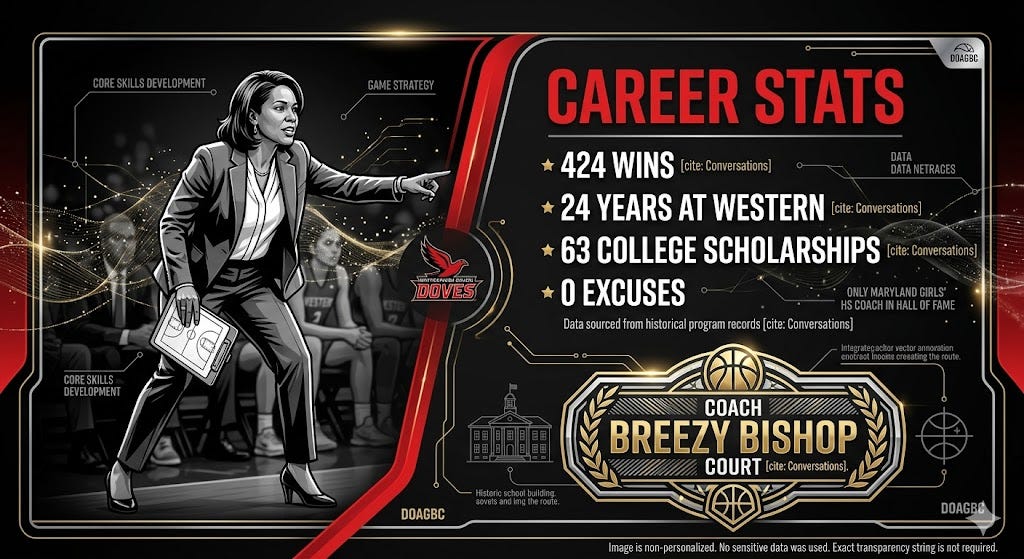
In 24 seasons at Western High School, she went 424-40. Seventeen Baltimore City championships. Two Maryland State Championships — back-to-back, in 1994 and 1995. Teams consistently ranked among the nation’s best by USA Today. Named Baltimore Sun All-Metro Coach of the Year in 1984, 1990, and 1995. Selected as the WBCA National High School Coach of the Year in 1995. Inducted into the Women’s Basketball Hall of Fame in 2000.
The win percentage is .914. In twenty-four seasons. That is not a number from a favorable schedule or a weak league. The Baltimore City public school athletic environment is one of the most competitive and physically demanding in the country. Western’s players came from all over the city, from neighborhoods where the conditions of daily life were often genuinely difficult. Breezy Bishop built her 424-40 record with those players, in that city, over twenty-four years.
For context: Lin James, the all-time regional wins leader, won 608 games over 48 years. Breezy Bishop won 424 games in 24 years. She won those games at a rate that, if she had coached another 24 years at the same pace, would have put her over 800 wins total. She is not behind Lin James. She is a different kind of great, operating in a completely different environment, at a completely different velocity.
The Booklet: What Nobody Else Was Doing
I want to spend real time on the “Doves” booklet because I think it is the most important thing Breezy Bishop did, and it is almost never discussed in the context of her coaching legacy.
In the 1970s, 1980s, and 1990s, women’s basketball players at public high schools in Baltimore City did not have agents. They did not have recruiting services. They did not have ESPN HoopGurlz rankings or national recruiting databases. They had whatever their coach did for them, and whatever their coach did was usually limited to answering calls when college coaches reached out.
Breezy Bishop did not wait for calls. She made the calls. She wrote the booklet. Every fall. Twenty pages. Self-funded. Mailed to every college in the country.
The Abell Foundation, which recognized her work, described it precisely: “Every fall the Doves fly into the athletic coach’s office of every college in the country — from Adelphi to Youngstown State, including the Naval Academy and West Point and the Ivies. Every college hears about my Doves.”
She was not just sending basketball statistics. She was sending academic information, character references, photographs, school context. She was providing college coaches with a complete picture of each player — not just what the player could do on the court but who the player was as a student and a person.
She had one standard she held publicly for her players: in seventeen years, she said, not one player had scored below 700 on the SAT — the threshold for athletic eligibility. Not one. She said this not to brag but to make a point about what her program actually produced: academically eligible, athletically competitive women who were ready for the next level.
The result: 63 of 64 players who applied for scholarships over seventeen years received them. One missed. Sixty-three succeeded. College attendance for the program ran above 85 percent for twenty years and above 90 percent for the five years preceding the Abell Foundation’s recognition of her work.
Dana Johnson did not play basketball before she arrived at Western High School as a freshman. Breezy Bishop found her potential, developed her game from nothing, and turned her into an All-American who received a full athletic scholarship to the University of Tennessee — Pat Summitt’s program, the greatest dynasty in the history of women’s collegiate basketball.
Johnson became the athletic director and boys’ basketball coach at Dunbar High School. Asked about Bishop at the 2022 court dedication ceremony, she said: “She was way ahead of her time. When it came to preparing us for the next level, it was like a seamless transition. We were doing things at the high school level that colleges were doing, so it wasn’t totally new to us when we got there. It was brilliant.”
Friday Rap Sessions: When the Coach Became a Listener
During basketball season, Bishop ran two-and-a-half-hour practices every day except Friday. On Friday, the team ran for an hour. And then they did something no other coach I have ever studied was documented doing on a regular basis.
They had rap sessions.
Not film sessions. Not chalk-talk sessions. Rap sessions — conversations. Circle-of-chairs sessions where Bishop listened to her players talk about their lives. She described it as the time when she learned the character of her players. She wanted to know what was happening at home, in the neighborhood, in the classroom. She wanted to know who she was actually coaching before she asked anything of them on the court.
Monica Dailey, who played for Bishop and graduated in 1990, described what those sessions produced over the long run: “What Coach Bishop has done is replicate herself in thousands of young women.”
That is a sentence that deserves to be read twice. Replicate herself. Not produce basketball players. Not develop athletes. Replicate herself — meaning that the qualities Bishop modeled for her players, the values she embedded in those Friday conversations, went out into the world inside the women who sat in that circle. They became teachers and coaches and administrators and mothers and professionals, carrying something they had received in a gym on the north side of Baltimore.
Tiffany Silver was the point guard on Bishop’s final teams at Western. She said Bishop was so demanding that Silver always felt she wasn’t good enough. When Bishop retired and Silver eventually stepped into a coaching role herself, Bishop was still there — coaching Silver, coaching her players, coaching the entire staff. “She still coached me, the players … the entire staff on how to coach young women,” Silver said. “We never took it for granted at that time, and we don’t take it for granted now.”
Kim Smith, Lafayette Court, and the Girl Who Was Scared of Her
Kim Smith grew up in Lafayette Court, a high-rise public housing project in Baltimore. She came to Western knowing she needed discipline. She got it — but not without a fight.
“She really didn’t like players doing a lot of talking,” Smith said of Bishop. “I walked out of practice at least once a week, but always came back.” Then she added this: “I was really scared of my mother. I was definitely afraid of her — but she didn’t know it.”
Smith was a star guard on Western’s 1994 and 1995 state championship teams. She went to Georgetown on scholarship. When things got difficult there — the way they sometimes do for young women navigating a new city, a new level of competition, and a new life away from home — she transferred.
She transferred to North Carolina State. She did not know, when she made that decision, that Breezy Bishop had just retired from Western and had been hired as an assistant coach at NC State — where the Wolfpack reached the NCAA Women’s Final Four for the first time in school history during Bishop’s one season there.
“She was such an anchor for me,” Smith said. “I was going to let this take me around the world. She left such an impression.” Speaking of Bishop’s words at the court dedication: “Things that she said to me when I was 14 years old, I say now.”
The relationship between Breezy Bishop and Kim Smith — a girl from Lafayette Court housing and the five-foot coach who terrified her and also saved her — is the Bishop story in miniature. It is the relationship repeated, in different forms, across hundreds of young women over twenty-four years.
The Hall of Fame, the Scholarship Fund, and the Tournament That Bears Her Name
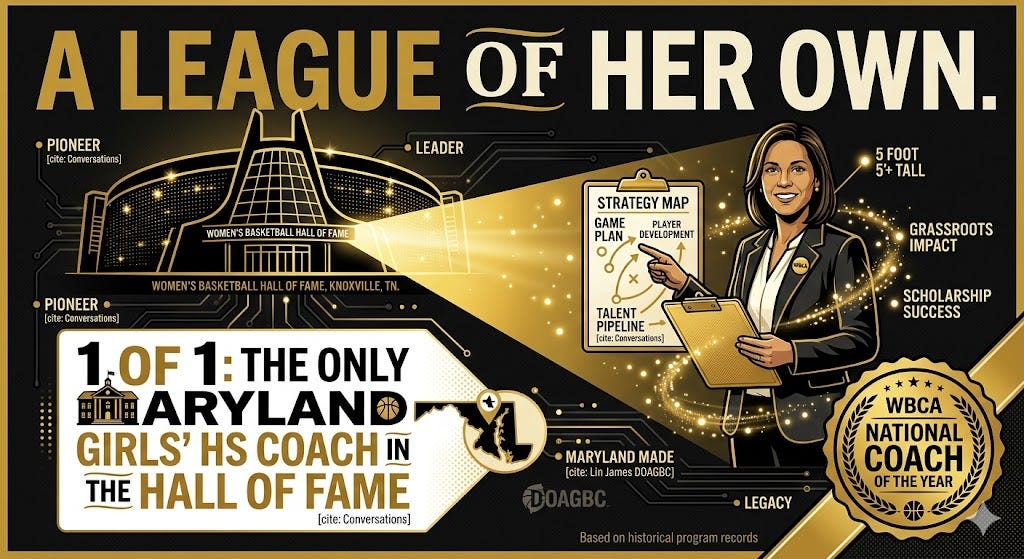
In 2000, Breezy Bishop was inducted into the Women’s Basketball Hall of Fame in Knoxville, Tennessee — the same city where the greatest women’s college basketball program in history was built by Pat Summitt, the program where Bishop sent Dana Johnson. She is the only Maryland girls’ high school basketball coach in the Hall. Not one of a few. The only one.
After Western, she coached collegiately — at Coppin State, at Johns Hopkins, at Towson State, and then for the 1997–98 season as an assistant at NC State. The Wolfpack made the Final Four that year. She then stepped out of coaching and returned to Baltimore, to the community she had always been serving.
She established a scholarship fund through the Baltimore Community Foundation — the Breezy Bishop Western High School Scholarship Fund — that awards a minimum of $10,000 annually to a deserving female graduate of Western, renewable for up to three additional years. She turned her legacy into an ongoing financial investment in the next generation of Western women.
The annual “Breezy Bishop Showcase” — a girls’ basketball tournament at the Western/Poly Athletic Complex — became the largest girls’ basketball tournament on the East Coast, drawing thirty-two teams from across the Mid-Atlantic region. ESPN HoopGurlz covered it. National programs competed in it. The best high school basketball in the region, gathered annually in Baltimore City, named for a woman who believed the women’s game deserved exactly that kind of visibility.
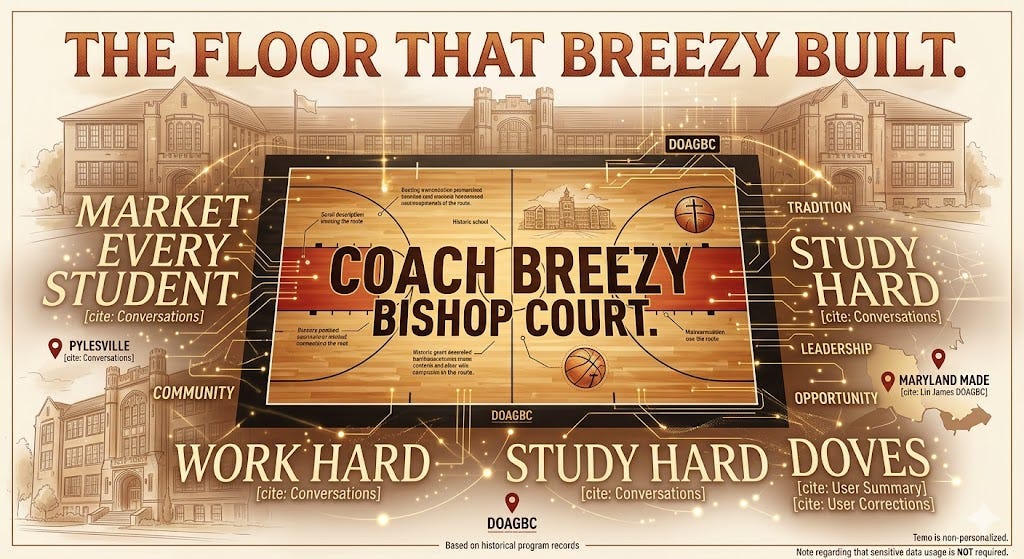
In September 2022, at the age of 87, she stood in the Eva Scott Gymnasium at Western High School as the court was dedicated in her name. Current coach Tasha Townsend — a 1993 Western graduate who played one season for Bishop — and star player Ny’Ceara Pryor presented Bishop with the championship ring from the 2021–22 state title, Western’s first since 1995.
She had been on the floor at the Xfinity Center in College Park months earlier when the Doves won that title. She watched her program win its first championship in twenty-seven years. Then they gave her a ring.
At the ceremony, she said: “The Lord has given me the grace to walk this earth for 87 years. I feel like maybe I did get it right.”
And then — according to the Baltimore Banner’s account of the day — she dropped the microphone.
Why I Chose Her: The Role Model from Across Town
Earlier in this series, in the piece about Jerome Shelton, I wrote that I had two coaching role models I watched from a distance when I was starting out. Jerome Shelton was one. Breezy Bishop was the other.
What I took from watching Breezy Bishop was something different from what I took from watching Shelton. Shelton taught me about consistency and humility, about the long game of building a program in one place. Bishop taught me about advocacy. She taught me that coaching girls’ basketball is not just about what happens inside the gym. It is about what you do on behalf of your players after the final buzzer every season.
The Doves booklet is the thing that changed how I thought about my responsibility as a coach. Here was a woman who looked at her players — young women from Baltimore City who were athletically gifted and academically eligible and who, without someone actively advocating for them, might never have gotten in front of the right college coaches — and she said: I will be that advocate. I will write the twenty pages. I will fund the printing. I will mail it to every college from Adelphi to Youngstown State.
She did not wait for the system to notice her players. She forced the system to notice her players. Every single fall. For seventeen years. Without a marketing budget. Without a recruiting service. Without any infrastructure except her own relentless belief that these young women deserved to be seen.
I am not Breezy Bishop. I have never done anything on the scale of what she did. But the principle she embodied — that the coach is not just a coach, that the coach is also a door-opener and a story-teller and an advocate for people who need someone in their corner — is one I carried from the moment I first understood what she had built.
What the Hall of Fame Means Here
The Women’s Basketball Hall of Fame is in Knoxville, Tennessee. Its mission is to preserve and promote the history of women’s basketball — from the first games played in a Massachusetts gymnasium in 1892 to the packed arenas of today. It is the definitive record of what the sport has been and who built it.
There is one Maryland girls’ high school basketball coach in that building. One name from this state, from this city, from the public school system that produced generations of young women who were coached, advocated for, educated, and sent into the world by a five-foot giant who wrote a twenty-page booklet every autumn.
Her name is Barbara Jude Bishop. They called her Breezy. She coached the Doves for twenty-four years. She won 424 games. She sent 63 of 64 players to college on scholarships. She was the WBCA National Coach of the Year. She put the floor at Western High School on the national recruiting map. And she is in the Hall.
She dropped the microphone in September 2022, at 87 years old, in a gymnasium named for Eva Scott at a school founded in 1844.
And she has been coaching coaches ever since.
Coach Breezy Bishop Court. Western High School. Baltimore, Maryland.
Diary of a Girl’s Basketball Coach · doagbc.substack.com · doagbc@gmail.com
The Breezy Bishop Western High School Scholarship Fund is administered by the Baltimore Community Foundation. For information, visit bcf.org.