
The Programs That Built Maryland
A Definitive Ranking of the Greatest Girls’ High School Basketball Programs in Maryland History — Measured by Championships, Wins, Coach Longevity, and the Players They Sent Into the World

I have been coaching girls’ basketball in this state for nearly thirty years.
I have watched programs rise and fall, watched dynasties built and dynasties ended, watched coaches give decades of their professional lives to gymnasiums in all corners of Maryland — from Pylesville in Harford County to Gambrills in Anne Arundel, from Harwood in the south to East Baltimore in the city, from the suburbs of Prince George’s County to the private school corridors of the IAAM and the WCAC.
This article is the product of that watching, and of the research this publication has been doing since we started building the DOAGBC database. It is our attempt to answer a question that serious Maryland girls’ basketball people have discussed for years without a definitive written answer: which programs, across all of Maryland’s history, have been the greatest?
Before we start, a few ground rules.
This ranking covers programs across all competitive structures: the MPSSAA public school tournament, the IAAM, the WCAC, and every other structure in which Maryland’s girls have competed. Comparing across those structures is inherently imperfect — a program that wins the IAAM A Conference competes in a different ecosystem than one that wins the Class 4A state title. We acknowledge that. We rank anyway, because the players and coaches of this state deserve to have someone attempt the full picture.
The criteria: wins, championships, longevity, the quality of players produced, and the degree to which the program shaped what came after it.
Let’s go.
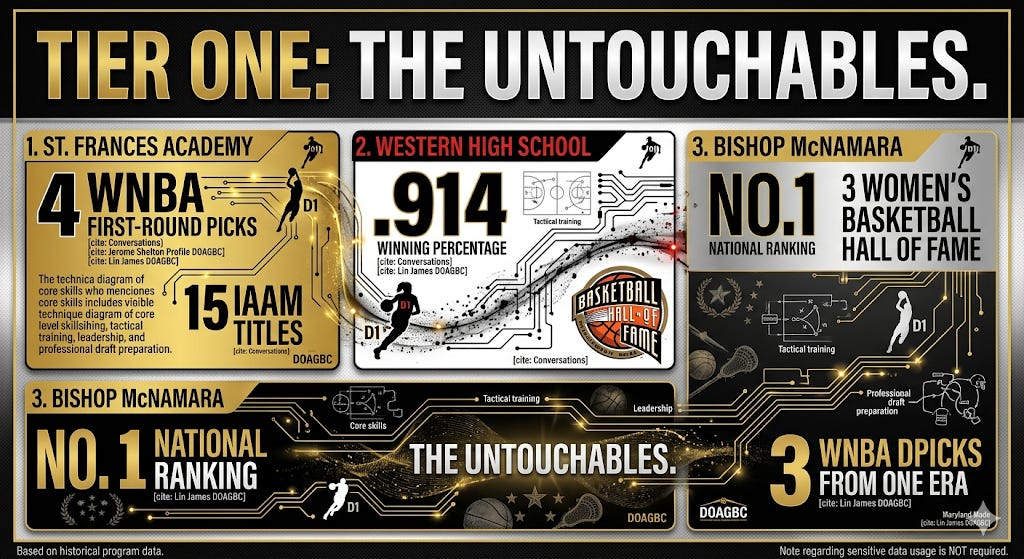
TIER ONE: THE UNTOUCHABLES
Programs that have produced the most championships, the most professional players, and the most lasting impact on the sport in this state.
No. 1: St. Frances Academy — East Baltimore
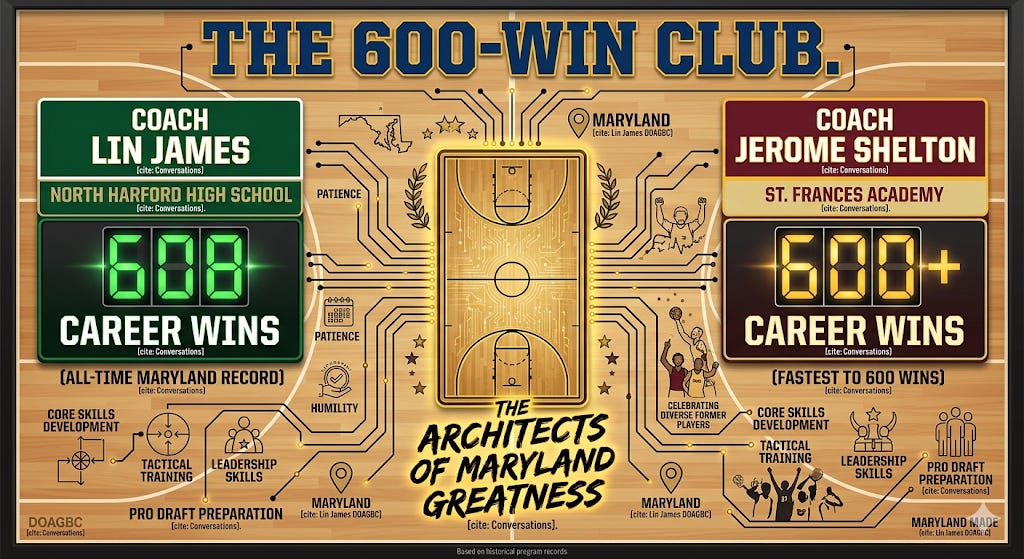
Coach: Jerome Shelton (1990–present) · Record: 600+ wins · Championships: 15 IAAM A Conference titles · WNBA First-Round Picks: 4
There is no serious argument for any other program at the top of this list.
St. Frances Academy has produced three first-round WNBA draft picks: Angel McCoughtry (No. 1 overall, 2009), Nia Clouden (No. 12, 2022), and Angel Reese (No. 7, 2024).
Jerome Shelton has coached at St. Frances for thirty-five years. He has won 17 IAAM league championships. He is second only to Lin James on the all-time regional wins list, and he reached 600 wins in fewer seasons than any coach in the area’s history. Two Olympic gold medals (McCoughtry, 2012 and 2016). WNBA All-Star selections - McCoughtry . One NCAA national championship (Reese, LSU, 2023). A Michigan State single-game scoring record (Clouden, 50 points). Multiple Big Ten and SEC Player of the Year awards between the three draftees.
The program is located at 501 East Chase Street in one of the oldest continually operating Black Catholic schools in the United States. The gym floor is named for Sister John Francis Schilling, who keeps the scorebook at every home game. McCoughtry and Reese stood in that gym in 2023 and talked to Baltimore’s youth about what was possible. Everything they said had been said, in different forms, on that same ground for almost two hundred years.
St. Frances Academy is the standard against which every other program in this state is measured.
No. 2: Western High School — Baltimore City
Coach: Breezy Bishop (1970s–1997) · Record: 424-40 (.914) · Championships: 17 Baltimore City, 2 State · Hall of Fame: Women’s Basketball Hall of Fame (2000)
The argument for Western at No. 2 begins and ends with the win percentage. A .914 winning percentage over 24 seasons, against public school competition in Baltimore City, is a number that should appear in conversations about the greatest coaching accomplishments in the history of the sport. Not the history of Maryland. The history of the sport.
Breezy Bishop is the only Maryland girls’ high school basketball coach in the Women’s Basketball Hall of Fame. She sent 63 of 64 players who applied for college scholarships to college on scholarships. She published and self-funded a 20-page recruiting booklet every fall, mailing it to every college in America, because she refused to let her players be invisible to the world that should have been seeing them.
Western’s championship years include two back-to-back state titles (1994-95), seventeen Baltimore City championships, and a perfect-season dynasty period where the program was consistently ranked among the best in the nation by USA Today. The school itself is the oldest female public high school in America, founded in 1844. Coach Breezy Bishop Court has been the gym floor’s official name since 2022. The current Doves program won its first state title since 1995 in 2022 — and Bishop was on the floor in College Park to see it.
No. 3: Bishop McNamara High School — Forestville, Prince George’s County
Coaches: Frank Oliver Jr. (2016–2023), Ron James (2023–present) · Championships: WCAC (2020, 2025, 2026), No. 1 National Ranking (2025) · WNBA Connections: 3 players drafted
The program that opened this series. Bishop McNamara has produced three WNBA draft selections from a single graduating class and era: Jakia Brown-Turner (Washington Mystics, 2024), Madison Scott (Dallas Wings, pick 14, 2025), and Liatu King (Los Angeles Sparks, pick 28, 2025). Scott and King were drafted on the same night from the same high school in Prince George’s County.
Operating in the Washington Catholic Athletic Conference — the most competitive girls’ basketball conference in the mid-Atlantic region — McNamara has twice won back-to-back WCAC championships (under Oliver in 2019-20 and under Ron James in 2025-26). The 2024-25 team went 30-2 and earned the No. 1 national ranking in High School on SI. The Team Takeover Girls pipeline, operated by Ron James since 2012, has produced eight McDonald’s All-Americans and more than 75 Division I players. McNamara is the current standard-bearer of the WCAC era, and its upward trajectory shows no signs of stopping.
TIER TWO: THE DYNASTY BUILDERS
Programs that sustained excellence across multiple eras, conference structures, or coaching generations.
No. 4: Arundel High School — Gambrills, Anne Arundel County
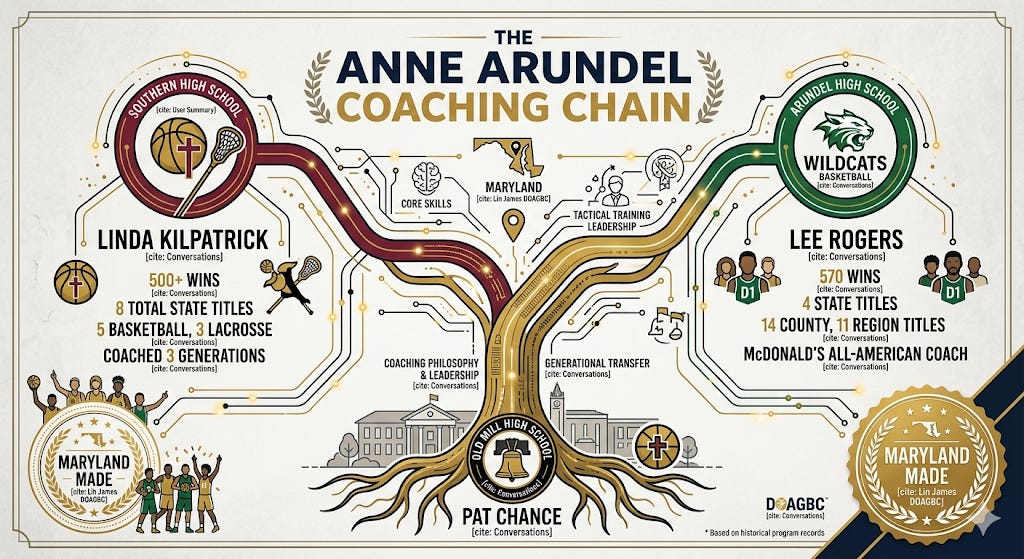
Coach: Lee Rogers (1989–2023) · Record: 570-251 · Championships: 4 State (1996, 2000, 2004, 2010), 14 County, 11 Region
The most successful girls’ basketball program in Anne Arundel County history, built over 34 years by a coach who went 6-16 in his first season and finished with 570 wins. Lee Rogers was selected to coach the West squad in the McDonald’s All-American Girls Game in 2018 — one of the highest honors in high school basketball coaching — and insisted on bringing his entire staff to Atlanta, including 34-year assistant Donna McGowan.
Arundel produced more than 50 college players, a large contingent at the Division I level, including Chavonne Hammond (Vanderbilt), Simone Egwu (Virginia), and Sherrone Vails (Louisville). The 89-game county winning streak. Four state titles spanning fourteen years. A court named for Rogers at the school — which he tried to refuse. This program is the model of what sustained excellence looks like at a public school without recruiting advantages.
No. 5: Hammond High School — Columbia, Howard County
Record: 3 State Championships (1992, 1994, 1995) · 5 Consecutive Final Four appearances (1991–95) · MPSSAA Class 3A
The most underrepresented dynasty in the history of Maryland girls’ basketball.
Hammond High School in Columbia won three MPSSAA state championships in four years (1992, 1994, 1995) and reached the state final four in five consecutive seasons (1991-1995). In the context of public school basketball in Maryland, that run places Hammond alongside the all-time programs in any era. The 1991-92 championship team won the Class 3A title. The back-to-back titles in 1994 and 1995 came during an era when Western was simultaneously winning Class 4A titles under Breezy Bishop, meaning Hammond was the state’s best smaller-school program exactly when Western was the state’s best large-school program.
Howard County has historically been underrepresented in the DOAGBC database and in the public record of Maryland girls’ basketball. Hammond is the clearest example of that gap. The full documentation of that five-year dynasty — the coaches, the players who went on to Division I programs, the individual stories — is one of the priority research projects for this publication.
No. 6: Southern High School — Harwood, Anne Arundel County
Coach: Linda Kilpatrick (1975–2015) · Record: 500+ wins · Championships: 5 State Basketball, 3 State Lacrosse
Five state basketball championships. Three state lacrosse championships. Eight state titles in two sports, at a public school, over 39 years, without the ability to recruit across county lines. Linda Kilpatrick came back to her own alma mater to build this program, was inspired by the boys’ basketball coach (Tom Albright, 550 wins) whose name is on the gymnasium, and in turn inspired Lee Rogers at Arundel to coach girls’ basketball.
The coaching chain that runs from Kilpatrick to Rogers is the most direct generational transfer in Anne Arundel County basketball history. Her court was dedicated at Southern in December 2023 — eight years after she retired, which is exactly the right amount of time for a community to fully understand what it had. In every decade she coached, her team reached the state final four
.
TIER THREE: THE RECORD-HOLDERS AND PERENNIAL POWERS
No. 7: North Harford High School — Pylesville, Harford County
Coach: Lin James (1967–2013) · Record: 608-229 · All-Time Wins Leader: Maryland/Regional
The all-time wins leader for girls’ basketball coaches in the Maryland and Baltimore region. Lin James arrived at North Harford in 1967 — five years before Title IX — and spent forty-six years building a program in rural Harford County that finished with 608 wins. No one has passed her. No one is close
.
The lack of national media coverage for a rural public school is the only reason Lin James and North Harford are not more widely known. She coached through the entire arc of the women’s game — from before Title IX to the era of the WNBA — at the same school, in the same community, for almost five decades. That consistency and that record belong at the top of any conversation about Maryland’s great coaches and programs.
No. 8: Riverdale Baptist School — Upper Marlboro, Prince George’s County
Coach: Sam Caldwell and others · League: WCAC · National: Perennial Top-10 rankings, multiple No. 1 regional designations
Riverdale Baptist has been a perennial presence in the Washington Post’s regional Top 20 rankings for more than two decades, regularly reaching No. 1 in the DMV area and competing with programs from across the country in national tournament settings. Operating in the WCAC alongside Bishop McNamara and other powerhouses, Riverdale Baptist has consistently produced Division I talent from Prince George’s County and beyond.
The program’s sustained national relevance — including multiple seasons finishing No. 1 in the regional poll, appearing in Dick’s Sporting Goods national tournament brackets, and competing against top programs from California and the Southeast — places it among the state’s elite even without multiple state championship banners. In a private-school league where the state tournament structure is different from the public school system, national rankings and head-to-head competition are the real measure.
No. 9: Old Mill High School — Millersville, Anne Arundel County
Coach: Pat Chance and successors · Championships: 3 State Titles (1992, 1993, and subsequent) · County perennial contender
Old Mill is the program that the MPSSAA record books list as winning three state championships in the early 1990s — 1992 and 1993 at the Class 4A level, coached by Pat Chance. Chance is one of the defining figures in Anne Arundel County girls’ basketball history: she mentored Linda Kilpatrick, she encouraged Lee Rogers to coach girls’ basketball, and she built a program at Old Mill that competed at the state level across three decades.
The Kilpatrick-Rogers-Chance coaching network that shaped Anne Arundel County girls’ basketball for thirty years has its roots at Old Mill, in the work that Pat Chance did before any of the others became well-known. That foundational influence earns the program its place in the all-time ranking.
TIER FOUR: THE HONORABLE MENTION — PROGRAMS THAT DEMAND RECOGNITION
C.H. Flowers High School (Prince George’s County): The 4A public school powerhouse of the modern era. Multiple recent county and region championships. Consistently ranked in the state’s top programs in the 2010s and 2020s.
Eleanor Roosevelt High School (Prince George’s County): Finished a perfect 26-0 season with the 4A state title in 2014. The benchmark for what a disciplined, well-coached public school program looks like at its peak.
Howard High School (Howard County): Won the Class 4A state title in 1994 — the same year Hammond won 3A, meaning Howard County produced two state champions in the same calendar year. An underappreciated achievement in a county whose basketball history deserves more documentation.
Largo High School (Prince George’s County): Three state championships (1997, 2007, 2016) across nearly two decades. A program that has been building and rebuilding and competing at the state level across different eras and coaching changes.
Linganore High School (Frederick County): Three state championships (1992, 1996, 1997) and multiple final appearances. One of the most successful rural-county programs in state history during the 1990s dynasty era.
What the List Tells Us
When I look at this list as a whole, several things stand out.
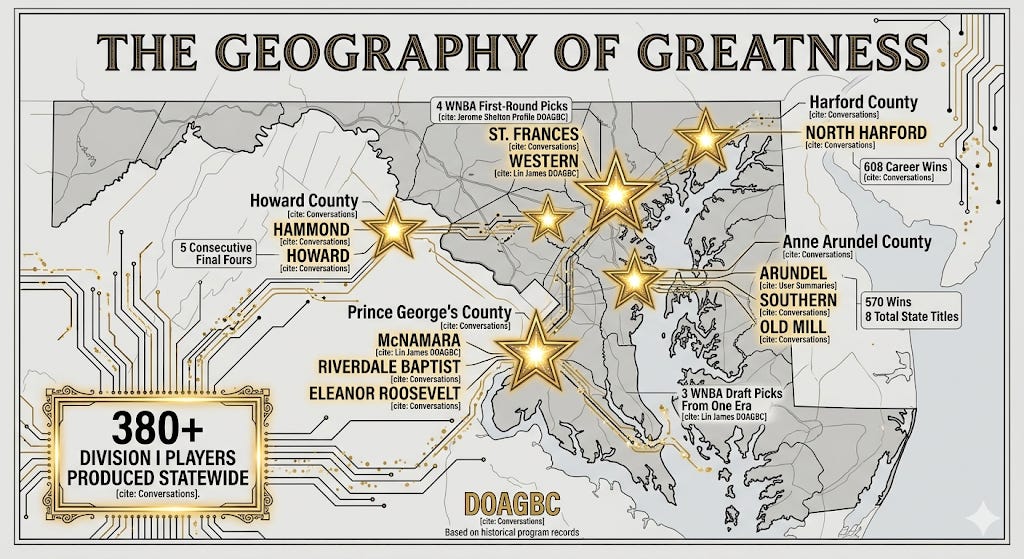
First: the geography of greatness in Maryland girls’ basketball is almost perfectly distributed across the state. Baltimore City (Western, St. Frances), Anne Arundel County (Arundel, Southern, Old Mill), Prince George’s County (McNamara, Riverdale Baptist, Flowers, Eleanor Roosevelt, Largo), Howard County (Hammond, Howard), Harford County (North Harford). The talent has never been concentrated in one place. It has come from everywhere, developed by coaches who stayed, and produced players who went everywhere
.
Second: the coaches who built the greatest programs are not interchangeable. Breezy Bishop was a marketer and an advocate who sent 63 of 64 players to college on scholarships. Jerome Shelton is a former soldier and history teacher who goes to clinics and holds himself accountable to the level of talent he is coaching. Lee Rogers is a former boys’ coach who was sent to girls’ basketball by three women who saw something in him he hadn’t seen in himself. Lin James is a woman from Tennessee who showed up in Pylesville before Title IX existed and refused to stop. Each of them is completely individual. None of them could have built what the others built.
Third: the private school and public school divide is real but not absolute. The IAAM and WCAC operate in different competitive structures than the MPSSAA. But the players who walk into those gyms are the same players who walk into public school gyms — they are Maryland girls, most of them from Maryland communities, most of them from families that have lived in this state for generations. The programs may compete in different structures. The mission is the same.
Fourth: there are significant gaps in this record that future research must fill. Hammond High School’s five-year dynasty deserves its own deep article. The coaches who built programs at Largo, at Linganore, at Eleanor Roosevelt, at Howard, at C.H. Flowers have not been profiled in this series yet. There are women who played at every one of these programs who went on to play Division I basketball, and their stories deserve to be told.
The Work Continues
Our database currently documents more than 380 Maryland women who played high school basketball in this state and went on to play Division I college basketball. The programs on this list are the factories and the cathedrals that produced them. The coaches profiled in this series — Shelton, Bishop, Rogers, Kilpatrick, Lin James — are the architects.
But the list of architects is long, and we have not profiled all of them. Not yet.
The coaches at Hammond in the 1990s dynasty years. Pat Chance at Old Mill. The coaches at C.H. Flowers and Eleanor Roosevelt and Largo who built competitive programs in Prince George’s County across multiple decades. The coaches at Linganore in Frederick County who won three state titles in six years. All of them built something real. All of them sent players into the world. Most of them have never been the subject of a published profile.
If you coached girls’ basketball at one of these programs. If you played for one of these coaches. If you know the stories that are not in the public record — contact us. The address is at the bottom of this page. The database is live. The research is ongoing.
Maryland girls’ basketball built all of this. We are trying to make sure the record reflects it.
QUICK REFERENCE: THE RANKINGS AT A GLANCE
No. 1 — St. Frances Academy (East Baltimore) · 3 WNBA first-round picks · 15 IAAM titles · 2 Catholic League titles - Jerome Shelton, 720 wins
No. 2 — Western High School (Baltimore City) · .914 win% · 17 city titles, 2 state · Women’s Basketball Hall of Fame (Breezy Bishop)
No. 3 — Bishop McNamara (Prince George’s County) · 3 WNBA draft picks · WCAC titles, No. 1 national ranking 2025
No. 4 — Arundel High School (Anne Arundel County) · 570 wins · 4 state titles · McDonald’s All-American coaching assignment
No. 5 — Hammond High School (Howard County) · 3 state titles · 5 consecutive Final Fours (1991-95)
No. 6 — Southern High School (Anne Arundel County) · 500+ wins · 5 state basketball + 3 state lacrosse titles · Linda Kilpatrick
No. 7 — North Harford High School (Harford County) · 608 wins (all-time regional record) · Lin James
No. 8 — Riverdale Baptist (Prince George’s County) · Perennial national Top 10 · WCAC powerhouse
No. 9 — Old Mill High School (Anne Arundel County) · 3 state titles · Pat Chance coaching legacy
Diary of a Girl’s Basketball Coach · doagbc.substack.com · doagbc@gmail.com
If you have information, corrections, or stories about programs not fully covered here — we want to hear from you.